East Berliners Oppose Mosque
Germans in a small East Berlin neighborhood are protesting plans to build a mosque there. They'd prefer their small garden plots to a minaret on the skyline.
Mosques are by no means a new development in Germany. As far back as the 16th century, Prussian king Frederick William I had the first mosque built in Potsdam for his Turkish soldiers.
In Berlin, the first mosque was constructed in 1924.
Now there are some 30 Muslim places of worship in the German capital. But most of them are in Neukölln and Kreuzberg, in the western part of the city. These are the neighborhoods in which the erstwhile guest workers of the 1960s and 1970s lived.
In the former Communist and, at the time, internationally insular East Berlin, there are no mosques. But the Muslim Ahmadiyya community would now like to build prayer rooms with a minaret in Heinersdorf, in the Pankow district.
Residents' fears are unfounded
The Ahmadiyya community is a small minority in Islam. Its members are often considered nonconformists and are even persecuted in countries such as Pakistan. In East Berlin, the group is also meeting with opposition, although most people there don't even know the difference between Ahmadiyya, Sunnite or Shiite Muslims.
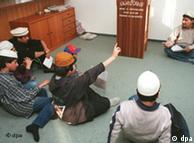 Bildunterschrift: Großansicht des Bildes mit der Bildunterschrift: Children in Berlin's Ahmadiyya community get religious instruction
The Ahmadiyya community claims to have some 200 members in Berlin. They present themselves as relatively liberal and clearly distinguish themselves from any form of fundamentalism.
"Love for all, hate for no one" a sign behind the imam's desk reads. Abdul Basit Tariq says he doesn't understand the opposition in Heinersdorf.
"These are unfounded fears," imam Tariq says. "People listen to the news, see scenes on television and that's why they're scared of Muslims. They think Muslims are terrorists and suicide bombers. Their heads are full of these things."
Politicians have decided over residents' heads
Karin Reinke, deputy of the local citizen's interest group fighting the mosque plans, says the neighborhood feels it should have been asked.
"In my opinion, if someone wants to be your neighbor, they come by, look at a property and then say 'hello, I want to be your neighbor'," Reinke says. "But we feel that the whole thing was dealt with over our heads, together with the politicians."
According to Reinke, this was currently "an explosive topic" and all citizens should be included in the decision process.
"I ask myself whether our representatives in the town hall, which we ourselves elected, are authorized to simply impose this on us?" she says.
A complicated battle
Heinersdorf is by no means an idyllic spot. It's a six-lane feeder road with a gas station, fast-food restaurants and a used-car dealer. Behind these are single-family houses and small garden plots.
 Bildunterschrift: Großansicht des Bildes mit der Bildunterschrift: Muslim integration is currently high on the agenda in Germany
The mosque is planned as a two-story building with a cupola and a small minaret. The plans have caused quite a stir.
An open council, which was intended to inform residents, had to be broken up. The right-wing extremist party NPD jumped on the bandwagon and organized a demonstration against the mosque, which in turn sparked a counterdemonstration.
The Heinersdorf residents don't know anymore who they should fight first: The district politicians from Pankow, which authorized the mosque in the first place? The right-wing extremists they're being lumped together with? Or the Ahmadiyya community behind the project?
It seems to be just too much for some residents since a mosque in Heinersdorf is foreign to their world view.
"When I read in all papers from Monday to Friday what sorts of consequences failed multiculturalism and failed integration programs have in this city, I'm worried," says resident Jürgen Kubisch. "The same thing when I hear how the Shiites and Sunnites are massacring each other in Iraq."
Fostering understanding for Islam
The Ahmadiyya community says it is coming in good faith and the mosque will be open to all visitors. According to imam Tariq, the group does not want to recruit new followers, as many residents fear.
None of the community even wants to live in the neighborhood. Most reside in western Berlin, in the Wedding district. But they can easily reach the Heinersdorf location, which is why the community chose it. It wants to stick to its plans in Heinsersdorf, despite the opposition.
The conflict has had one positive effect. Many residents have been learning much more about Islam in the past weeks, which might be a first step towards mutual understanding.
posted by none @ 2:10 AM
0 comments

